Europe - Things you must know

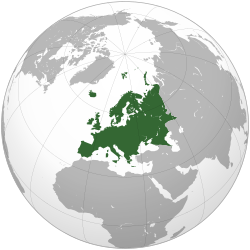
Europe (pronunciation: /ˈjʊəɹəp/ yewr-əp; /ˈjuɹəp/ or /ˈjəɹəp/ yur-əp) is, by convention, one of the world's seven continents. Comprising the westernmost peninsula of Eurasia, Europe is generally 'divided' from Asia to its east by the watershed divides of the Ural and Caucasus Mountains, the Ural River, the Caspian and Black Seas, and the waterways connecting the Black and Aegean Seas. Europe is bordered by the Arctic Ocean and other bodies of water to the north, the Atlantic Ocean to the west, the Mediterranean Sea to the south, and the Black Sea and connected waterways to the southeast. Yet the borders of Europe—a concept dating back to classical antiquity—are somewhat arbitrary, as the primarily physiographic term "continent" can incorporate cultural and political elements.
Europe is the world's second-smallest continent by surface area, covering about 10,180,000 square kilometres (3,930,000 sq mi) or 2% of the Earth's surface and about 6.8% of its land area. Of Europe's approximately 50 states, Russia is the largest by both area and population (although the country has territory in both Europe and Asia), while the Vatican City is the smallest. Europe is the third-most populous continent after Asia and Africa, with a population of 733 million or about 11% of the world's population. In 1900, Europe's share of the world's population was 25%.
Europe, in particular Ancient Greece, is the birthplace of Western culture. It played a predominant role in global affairs from the 16th century onwards, especially after the beginning of colonialism. Between the 16th and 20th centuries, European nations controlled at various times the Americas, most of Africa, Oceania, and large portions of Asia. Both World Wars were largely focused upon Europe, greatly contributing to a decline in Western European dominance in world affairs by the mid-20th century as the United States and Soviet Union took prominence. During the Cold War, Europe was divided along the Iron Curtain between NATO in the west and the Warsaw Pact in the east. European integration led to the formation of the Council of Europe and the European Union in Western Europe, both of which have been expanding eastward since the fall of the Soviet Union in 1991.


Area 10,180,000 km2 (3,930,000 sq mi)o[›]
Population 731,000,000o[›] (2009, 3rd)
Pop. density 70/km2 (181/sq mi)
Demonym European
Countries 50 (List of countries)
Languages List of languages
Time Zones UTC to UTC+5
Internet TLD .eu (European Union)

Source

Outrageously - Designed Hotels


With these transparent bubble tents, campers can sleep under the stars without sacrificing any creature comforts. Created by French designer Pierre Stephane Dumas, these "Bubble Trees" are designed to help people get intimate with nature. Available only in Europe for now, the inflatable see-through shelters give campers panoramic views of their surroundings. But they don't come cheap. According to the U.K.'s Daily Mail, one night in a "Bubble Tree" costs about $650. (Solent/Splash)


Ever feel as if every hotel room looks like the last one you checked into? Next time, consider spicing up your travel by staying at one of these unique hotels, where style often trumps all else.
The Treehotel in Sweden aims to bring guests close to nature and rekindle joyful childhood memories. A group of modern designers and architects were charged with designing different rooms. The result: six unique spots to stay high above the forest floor.
(Courtesy Treehotel)


The Balancing Barn takes sleeping to new heights. From the road, the barn – shown here nearing completion - is almost invisible. But from the other side, the barn offers a stark contrast to the serene countryside. Half of the house is cantilevered over a descending slope, giving a wide view of the British landscape. It's not a hotel; there are no services. But it sure is a unique spot to rent out. The barn sleeps 8 and costs about $1,100 for four nights. (Living Architecture)


Want to see the Northern Lights and the stars shining brightly in the arctic sky? Stay in a glass igloo at the Hotel Kakslauttanen, which is located above the Arctic Circle in Finland. For those visitors wishing to have a truly arctic experience, you can stay in one of the traditional snow igloos, eat in the snow restaurant or even get married in the snow chapel. (Hotel Kakslauttanen)


Hotel Kakslauttanen features a glass igloo village, log cabins, and the world's largest smoke sauna. The glass igloos maintain a normal room temperature and the glass ceiling stays clear of snow so guests can enjoy the beautiful night sky. (Hotel Kakslauttanen)


German artist HA Schulte designed the Save the Beach hotel, which was made entirely of garbage and other debris collected on beaches. The Corona beer company commissioned the hotel as part of its Save the Beach campaign, which is the beer maker's effort to reduce garbage and pollution of Europe's beaches. The five-room hotel was open for four days on Rome's Castel Sant'Angelo and accepted visitors like supermodel Helen Christensen through a competitive process. (Save The Beach )


In Christchurch, New Zealand luxury meets history at Wagon Stays, a small hotel that offers exactly what its name presents: a chance to stay in one of those old covered wagons that the pioneers used. But don't fret, this won't be roughing it. The wagon comes with air conditioning, a toilet, shower and even a hair dryer and flat-screen TV. (Wagon Stays)


We've all woken up from deep sleep feeling a bit blue. But at the Conrad Maldives Rangali Island some guests now have the chance to awake under the deep blue with schools of fish swimming by and rays of sunlight shimmering through the water to the new Ithaa Suite. The room sits 16 feet below the Indian Ocean, surrounded by a vibrant coral reef and encased in clear glass. (Courtesy Conrad Maldives Rangali Island)


The Boot Bed N' Breakfast in New Zealand is the brainchild of Steve Richards, who designed the two-story cottage in the shape of a giant boot. Outside is a grove of hazelnut trees. Inside, an open fire for a romantic evening in. And when you wake from your fairy tale night, breakfast will be waiting at your door. Make all the footwear jokes you might, this hotel uses free-range eggs offers fresh fruit from its orchard in your meal. ( Boot Bed N' Breakfast)


The Dog Park Inn is a bed and breakfast inside a Beagle in Cottonwood, Idaho. Furnishings include chainsaw dog carvings, and the inn serves what they like to call the Prairie's Best Fruited Granola. Can't spend the night? Don't fret, the inn has a gift shop that sells some of those dog carvings for all you canine fans. (Dog Park Inn )


Sticking with the nautical theme is the Utter Inn in Stockholm, Sweden. It was designed by a local artist and opened in June 2000. The small red house above the lake leads to a tiny underwater bedroom with two twin beds. Don't worry there is room service, but you need to order well in advance. (Utter Inn)


We can all strive for environmentally-friendly travel, but at one Arizona hotel you can actually live the green lifestyle. The Phoenix Earthship offers people the chance to stay in self-sufficient housing made from recycled materials. It even comes with its own lush interior jungle. (Phoenix Earthship)


To get publicity for its new logo and redesigned rooms, Holiday Inn hired world record-holding cardstacker Bryan Berg to build a 400 square foot Key Card Hotel that is on display at the South Street Seaport in Manhattan. It features a bedroom, bathroom and lobby all made out of key cards. More than 200,000 cards were used and it weighs 4,000 pounds. And yes you can sit on the furniture. (Courtesy Holiday Inn)


The Madonna Inn's Jungle Rock room is one of the largest, featuring two king-size beds. The room, which goes for $240 a night, features a waterfall shower to clean up after all your jungle fun. (Madonna Inn)


From 1955 to 1979, this lifeboat saved scores of sailors from all but certain death off the British coast. Now the Lilla Marras offers you a place to get some shut eye if you find yourself in Harlingen, the Netherlands. A night on the Lifeboat hotel will cost you about $320. (Lifeboat Hotel)


If you are more of a land lover, consider the Lifeboat's sister hotel, the nearby Lighthouse hotel. For 75 years, this lighthouse protected boaters but was decommissioned in 1998 and is now a hotel. But there is room for only two people a night and staying there comes at your own risk. (Lighthouse Hotel)


The Controversy Tram-Inn offers guests the opportunity to sleep on a train or in two trams that were active several years ago in Germany and Amsterdam. The hotel in Hoogwoud, the Netherlands, strives to have fun with its rooms. The train includes a Jacuzzi built in a Mexican sombrero. (Controversy Tram-Inn )


The Crowne Plaza at Union Station in Indianapolis is built in the city's former train station, America's 1st Union Station. The Grand Hall is marked with distinctive arches, columns and terrazzo floors and features a stained-glass barrel ceiling along with two identical 20-foot leaded stained glass wheel windows. While most guests stay in traditional rooms, the hotel does offer the opportunity to spend the night in a Pullman train car. (Crowne Plaza at Union Station)


Want more train and less station in your stay? Consider the Aurora-Express, a bed and breakfast in Fairbanks, Alaska, made out of authentic Alaska Railroad cars renovated to historical periods. Mike and Sue Blomfield Wilson bought the railcars from the Denali National Park Hotel for only $1 apiece -- but did have to spend thousands of dollars to transport them. (Aurora-Express)


The Out 'n' About Treesort in Cave Junction, Ore., offers the kid in all of us to spend a night up in the trees. The resort features 18 different treehouses, platforms and forts plus seven swinging bridges, five swings, 20 flights of stairs, four ladders and a ropes course with a 160-foot zip line. (Out 'n' About Treesort)


The Ariau Amazon Towers is the only hotel complex at tree top level in the Amazon rain forest. It is located 35 miles northwest of Manaus, Brazil, on the right bank of the Negro River. The 260 bedrooms, 11 suites and nine treehouse Tarzan suites are spread out in eight wood towers linked by 30-foot-high catwalks. (Ariau Amazon Towers)


The plane's interior is Costa Rican teak paneling from the cockpit to the tail. Furnishings are hand-carved, teak furniture from Java, Indonesia. The suite features two air-conditioned bedrooms -- one with two queen-sized beds and the other with one queen-sized bed, each with its own private bath. (Courtesy Hotel Costa Verde )


The plane's interior is Costa Rican teak paneling from the cockpit to the tail. Furnishings are hand-carved, teak furniture from Java, Indonesia. The suite features two air conditioned bedrooms -- one with two queen sized beds and the other with one queen sized bed, each with its own private bath. (Courtesy Hotel Costa Verde )


This isn't your typical airplane restroom. There is plenty of room to spread out and even a view. (Courtesy Hotel Costa Verde )


The room also includes flat screen TVs, a kitchenette, dining area foyer; an ocean view terrace; a private entrance up a river rock, spiral staircase and 360 degrees of surrounding gardens. (Courtesy Hotel Costa Verde )


But you didn't come here for the plane. You came for the views. Sure it might cost you $300 to $350 a night, but isn't this worth it all? (Courtesy Hotel Costa Verde )


The Capsule Hotel in The Hague lets guests feel like they are castaways from a shipwreck. These bright orange pods were originals survival pods from an oil rig and now serve guests who are looking for a little adventure in their vacation. (Capsule Hotel)
Get Arround By Car

The ease of driving on the continent varies greatly, and as a general rule east and west of the old iron curtain are two different worlds. Western Europe for the most part have good road conditions and an extensive and well developed highway network, whereas Eastern Europe are still working hard on the great backlog left behind from communist days. During vacations, especially during summer and Christmas vacations, driving on the highways can be hellish, particularly in Germany (listen for the word Stau in the automated traffic broadcasts).

Road rules
There are no uniform speed limits across the union, the fabled limitless German autobahn is now limited to mostly rural sections. The majority of highways have a 110-130 kph (70-80 mph) speed limit while Italy boasts 150 kph (94 mph) on stretches of highway that are 6 lanes or wider. For North Americans, a major difference is the left lane on highways, which are not the "fast lane" you're used to, but rather the "passing lane", it's illegal to overtake on the right, so you should only occupy the outer lane when you are overtaking someone, stay there, and you will have other vehicles tailgating while flashing their lights in annoyance and traffic police eager to fine you. Remember to use turn signals when changing lanes.
Except for priority streets (check the symbol in the table) there is a general duty to give way to traffic from your right in crossings and intersections that are not marked, and other drivers have every expectation you adhere to this. But in the ubiquitous roundabouts (circles) you find everywhere across the continent, cars already in the circle always have the right of way, don't give way to incoming drivers while in the roundabout, or you will mess up the system, potentially causing some nasty accidents. Finally, don't do right turns on red lights (unless the light features a green right arrow sign, in which case right turns on red are permitted), it's illegal, and because it's not common practice, also dangerous.
Markings and signs are similar throughout Europe but variations in design and interpretations exist so it may be very practical to research each country individually before you travel
Avoid large cities if you are not used to driving in Europe. Most city centres were built long before the introduction of the auto-mobile, and were not meant to cope with the levels of traffic common these days. So for the most part it may be a slow, frustrating and potentially dangerous experience, and even then, finding a parking spot can potentially take a long time and cost an arm and a leg when you find it. Streets in the old city centres also tend to be very narrow and difficult to drive on. In addition, Instead Park at the outskirts of town, where it is often free, and use the, usually extensive public transit system instead. If you are renting, try to work around having a car while visiting large cities.
Age: Almost everywhere, especially in the EU, you need to be 18 years old to drive, even supervised, and in countries with Learning schemes, it's usually an exhaustive procedure to get a permit, and rarely applicable to foreign citizens anyway. Exceptions include Portugal, Ireland and the UK.
Equipment
A warning triangle is compulsory nearly anywhere, and so is using it in case of breakdowns.
Hi-Visibility (reflective) vests are compulsory in Austria, Belgium, Bulgaria, Croatia, France, Germany, Italy, Norway, Portugal and Spain and gaining popularity elsewhere.
Headlamp Adjusters are also compulsory equipment in most countries, but in the U.K. and Ireland only if you are driving a continental car.
Paperwork
Original Registration Document is compulsory
Motor vehicle insurance certificate is compulsory
A black and white, 1-3 letter country identity sticker is compulsory for cars without EU license plates.
International driving permit, while it's not compulsory for certain nationalities in some European countries, it's cheap, and could potentially save you from nasty incidents with authorities.
If you plan on renting a car for driving across Europe, it often makes sense to check the rates in different countries rather than just hire a car in the country of arrival. The price differences can be very substantial for longer rentals, to an extent where it can make sense to adjust your travel plans accordingly. I.e. if you plan on travelling around Scandinavia by car, it will often be much cheaper to fly into Germany and rent a car there. Compared to North America, you should be prepared for smaller, but more efficient cars, and automatics are rarely available ant at extra cost, never expect one without requesting it while placing your order.
In any case driving in Europe is an expensive proposition, gas prices hovers around $7-8 per gallon (€1.30-1.50 per litre) in much of western Europe, while often slightly cheaper in Eastern Europe. Rentals are around 2-3 more expensive than in North America, Highway tolls are very common, city centre congestion charges increasingly so, and even parking can work up to €50 ($70) per day in the most expensive cities. Driving can be an enjoyable and feasible way to see the countryside and smaller cities, but most Europeans would find a vacation to say, Paris, Brussels and Amsterdam, in a rented car completely laughable.

Source: Wikitravel

The Most Important Thing To Have When You Travel!

It is always wise to have a travel guide when you go on vacation. They can provide an overview of the most important thing you need to know about your holiday destination.

One of the best investments you can do before a trip is a guidebook. Whether you want to lie at home in the hammock and dream away, are newly arrived in the bus station and wonder where you are or will be away on a weekend to a busy metropolis, this is usually observations in any guidebook.

Transportation

Everything from tips for traveling Rickshaw, Tuk-Tuk procedure camel riding and hiking to practical information about which bus goes where and how much the train costs are included in most guidebooks.

Accommodation

One of the most valuable with a guidebook is the security it gives you when you arrive late at night, it's dark (and probably rain) and all you want, a good soft, dry bed! Then it is always nice to be able to turn up your guide book and have a list of recommended accommodation where you can point to its first best taxi driver. Most guidebooks also offer accommodation in several price categories, from the cheapest to the most expensive, which makes it easy to choose a home that suits your wallet.

Maps and map books.

Another very useful thing to have in a guide book is maps that are over both land and cities. This is not an obstacle to be broken, but is an invaluable help to get back at least!

History and background facts

Many travel guide books have a good part of the country or the city's history and special chapters on such as food, crafts, social situation, etc in them. Often there's also chapters on how to travel in a respectful manner to both nature and people.

Lonely Planet guide books published since the mid-1970s, and now has one hundred guides in almost all countries in the world. They offer everything from budget traveler's best friend "the Shoestring Guide to the City Guides for New York and Tokyo. It's not for nothing that the Lonely Planet guide books are often called "the Bible" because of their faithful and many supporters!

Other guide books

Other popular guidebooks including Rough Guides, Footprint and Wilma's travel books are very good for the Swedes. As always, there are both advantages and disadvantages of each guide books. Footprints which specializes in Latin America and their popular guide to South America is a big competitor to Lonely Planet in this part of the world. Footprints guide book also has much better maps than as Lonely Planet and often large parts of the world. For those who want to follow the current, the recommended is one of many Lonely Planet guidebooks, while those who want to find "their" hotel do better to choose one of the competing guidebooks.

Article written by: Christer Nyrud.
Article Source: http://EzineArticles.com/5090157

EuroTrip Project Socializing

It's time for social networking so here we are.....

Find us on facebook
Follow us on twitter
Watch our channel on youtube

Some Polls Have been added

I have just added some polls that need to be answered and so we can have a Start Point for our Project.
Please answer seriously to the polls because they will be our guide to this Journey.

Welcome to The Euro Trip Project

Welcome to the The Euro Trip Project. Stay tunned for further updates of the project
abcs